How Fast-Food Brands Use OOH Advertising to Launch New Menus in a HFSS World
New menu launches have always been a defining moment for fast food brands. From limited edition burgers to seasonal sides and collaborations, these products rely on immediate awareness and mass reach to succeed. In the current UK advertising landscape, ooh advertising has become one of the most effective ways to deliver that reach, particularly as HFSS regulations continue to restrict how and where food brands can promote products high in fat, salt and sugar.
The introduction of HFSS guidelines has reshaped food marketing over the past few years. Designed to reduce childhood exposure to unhealthy food messaging, the rules limit advertising of HFSS products across paid online channels and around content aimed at under 16s. While ooh advertising is not banned, it requires careful planning. Location, creative execution and messaging all matter, especially near schools or environments with a high concentration of younger audiences. As a result, brands have had to become more strategic rather than simply louder.
Fast food brands have responded by leaning into the strengths of outdoor advertising. Ooh environments offer scale, frequency and physical presence, all without relying on targeted digital delivery. A new menu item placed across high footfall city centres, commuter corridors and transport networks reaches adults repeatedly during routine journeys. That repetition is essential when introducing a product that consumers have not yet tried.
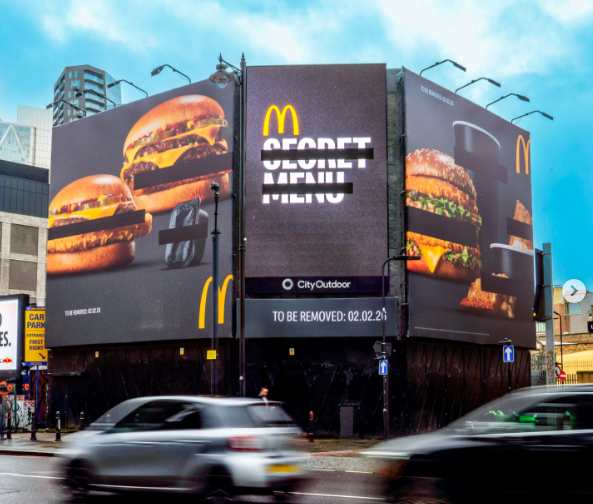
McDonald’s remains one of the most consistent users of ooh advertising for menu innovation. When launching items such as the McPlant or limited time wraps and sauces, the brand has used bold, minimal creative across roadside formats, rail environments and urban street media. The focus is rarely on nutritional detail. Instead, the work centres on product cues, brand colour and recognisable typography, ensuring instant recognition even at speed.
KFC has taken a similar approach with new chicken ranges and return favourites. Its ooh advertising often leans into appetite appeal through close-up visuals and short, confident copy. By placing this creative across transport corridors and city centres, KFC ensures exposure during lunch and evening travel peaks, moments closely linked to purchase intent. These placements allow the brand to build awareness without relying on digital formats that may be restricted under HFSS rules.
Burger King has increasingly used ooh advertising to spotlight plant based and reduced meat options alongside core menu launches. This strategy serves two purposes. It introduces new products while also signalling broader brand intent, which can be helpful when navigating public and regulatory scrutiny. Large format outdoor advertising gives these launches a sense of legitimacy and scale that social media alone cannot replicate.
Limited time collaborations have also found a natural home in ooh advertising. Taco Bell, Popeyes and Five Guys have all used outdoor formats to build anticipation around new menu drops, often using simple countdown messaging or oversized product imagery. In an HFSS context, the emphasis shifts from persuasion to presence. The goal is to be seen everywhere so that the product feels unavoidable rather than overtly promoted.
What makes ooh advertising particularly effective for fast food brands is its ability to work alongside in store and app-based messaging. A commuter might see a new menu item on their journey, encounter it again near a retail location, and then be prompted to order via an app once inside. Outdoor advertising becomes the connective tissue between awareness and action, especially when other channels face increasing regulation.
As HFSS guidelines continue to evolve, fast food brands are unlikely to reduce marketing spend. Instead, they will keep shifting budgets into environments that offer certainty, scale and creative flexibility. Ooh advertising provides all three. It allows brands to launch new menus confidently, stay visible in competitive urban spaces, and remain part of everyday culture without relying on restricted digital formats.
For fast food marketers, the lesson is clear. In a regulated advertising landscape, success comes from understanding how to use space as much as message. OOH advertising gives fast food brands the room to introduce new menus boldly, responsibly and at the scale required to drive real-world demand.